The Holy Mass, the central act of worship in the Catholic Church, is far more than a simple commemoration. It is a profound participation in the salvific sacrifice of Jesus Christ, a re-presentation of His Passion, Death, and Resurrection. The sacred liturgy, rich in symbolism and tradition, unfolds through a carefully orchestrated series of actions, words, and gestures. Integral to this sacred performance is the use of liturgical vestments, which not only distinguish the clergy but also imbue the celebration with a deep spiritual significance, connecting the faithful across centuries to the very origins of the Church, from the empty tomb to the ongoing mission of the Third Millennium.
The Symbolism of Vestments: A Visual Catechesis
Liturgical vestments are not mere garments; they are a visual catechesis, teaching the faithful through their colors, designs, and historical lineage. Each vestment carries a symbolic weight, reminding those present of the sacred nature of the moment and the divine office being fulfilled by the minister. The very act of vesting is a ritual in itself, a gradual preparation of the priest for his encounter with the divine. This preparation is mirrored in the transition from the everyday to the sacred, marked by the donning of vestments that elevate the ordinary into the extraordinary.
The Chasuble: A Symbol of Charity and the Yoke of Christ
Chief among the vestments is the chasuble, the outermost garment worn by the priest during Mass. Its origin can be traced back to the Roman paenula, a practical outer garment. Over time, however, its form evolved, becoming more ornate and symbolic. The chasuble, particularly in its modern form, represents the yoke of Christ, a reminder of His gentle burden and the call to carry one’s cross with love and dedication. The fullness of the chasuble also symbolizes charity, the greatest of virtues, enveloping the priest as he stands as mediator between God and His people. The colors of the chasuble are perhaps its most immediately recognizable symbolic feature, each hue appointed for specific seasons and feasts, guiding the faithful through the liturgical year and its diverse spiritual themes.
The Stole and Maniple: Emblems of the Priest’s Ministry
Worn across the shoulders, the stole is a direct symbol of the priesthood itself. It signifies the authority granted to the priest by Christ to administer the sacraments and preach the Gospel. The stole represents the priestly office, the vestments appropriate for the minister of God. In conjunction, the maniple, though less commonly seen in some modern liturgical expressions, was historically worn on the left arm and symbolized the priest’s readiness to perform his sacred duties and his potential for sin, reminding him of the need for humility and constant vigilance.
The Dalmatic and Tunic: Vestments of Service
For the deacon, the dalmatic serves a similar role to the chasuble for the priest. It is a symbol of joy and service, reflecting the deacon’s specific role in assisting the priest at the altar, proclaiming the Gospel, and serving the needs of the community. The tunic, worn by the subdeacon (in older forms of the liturgy), further emphasizes the hierarchical nature of the liturgical assembly and the coordinated service of all its members.
The Colors of the Liturgy: A Tapestry of Meaning
The liturgical colors are a vibrant language that speaks volumes about the mysteries being celebrated. White and gold, the colors of joy, purity, and triumph, are reserved for feasts of Our Lord, the Blessed Virgin Mary, the angels, and saints who were not martyrs. Red signifies the fire of the Holy Spirit, the blood of martyrs, and the Passion of Christ, used on Pentecost, Palm Sunday, Good Friday, and feasts of martyrs. Green is the color of hope and perseverance, used during Ordinary Time, symbolizing the growth of the faithful in Christ. Violet, the color of penance and anticipation, marks the penitential seasons of Advent and Lent, calling the faithful to reflection and conversion. Rose is a color of joy, permitted on the Third Sunday of Advent and the Fourth Sunday of Lent, offering a foretaste of the coming celebration.
The Significance of Embroidery and Design
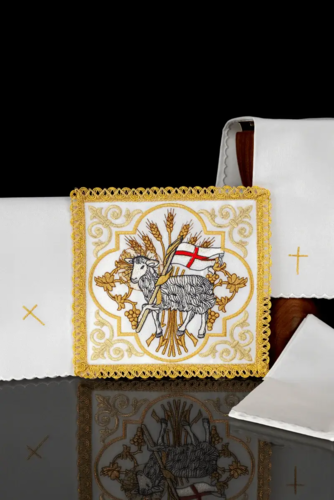
Beyond color, the intricate embroidery and symbolic designs adorning vestments further enrich their spiritual message. Motifs such as the Chi-Rho (the first two Greek letters of Christ’s name), the IHS monogram (an abbreviation of Jesus’ name in Greek), the cross, representations of the Trinity, the Blessed Virgin Mary, and various saints all serve to draw the attention of the faithful to the divine mysteries being enacted. These detailed embellishments are not merely decorative but are integral to the vestment’s role as a sacred object that proclaims the faith.
From the Empty Tomb to the Third Millennium: A Continuous Tradition
The unbroken tradition of liturgical vestments connects the faithful of today to the earliest Christian communities. The empty tomb, the site of Christ’s ultimate victory over death, is the foundational event upon which the Church and its liturgy are built. The priests and deacons, vested in these sacred garments, stand in continuity with the Apostles and their successors, carrying forward the ministry entrusted to them. As we move deeper into the Third Millennium, the enduring beauty and profound symbolism of full liturgical vesture serve as a powerful reminder of the timeless nature of the Holy Mass and its central role in the life of the Church. They are a testament to the enduring presence of Christ, from the dawn of Christianity to the present day, and a promise of His continued presence until the end of time.
https://chasubles.com/collections/easter
Priest Chasubles – Chasubles.com