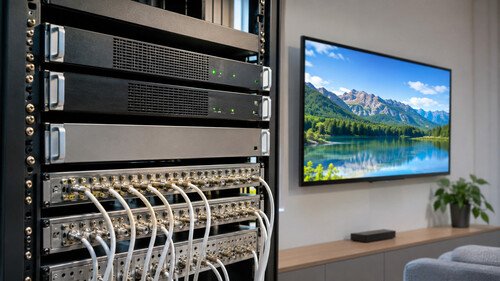
The television broadcasting industry has undergone significant technological changes over the past decade. As viewers demand higher picture quality, more channels, and seamless access to entertainment, television service providers must adopt flexible and efficient distribution technologies. Two essential solutions that support modern broadcasting infrastructures are IP video transcoding and QAM cable TV distribution. IP video transcoding allows broadcasters to convert video streams into different formats, resolutions, and bitrates, ensuring compatibility with various transmission networks and receiving devices. Meanwhile, Quadrature Amplitude Modulation (QAM) enables the efficient transmission of digital television channels over traditional coaxial cable networks. Combining these technologies provides a practical solution for cable operators, hotels, hospitals, residential complexes, and other organizations that require reliable television distribution. By integrating IP-based video processing with QAM modulation, operators can deliver high-quality digital television services while optimizing bandwidth and utilizing existing cable infrastructure. This article explores how IP video transcoding and QAM cable TV distribution work, their main benefits, essential components, practical applications, and their importance in modern television broadcasting systems.
What Is IP Video Transcoding?
IP video transcoding is the process of converting digital video streams from one encoding format, bitrate, or resolution into another while maintaining compatibility with the target distribution system. Television content can arrive through different sources, including IPTV networks, satellite receivers, streaming servers, and digital broadcasting systems. These sources may use different compression standards, such as MPEG-2, H.264/AVC, or H.265/HEVC. Not all television receivers and distribution platforms support the same formats. Therefore, transcoding becomes necessary when video content must be adapted to specific network requirements or device capabilities. For example, a television operator may receive an H.265-encoded video stream through an IP network but need to distribute it to older cable television receivers that only support MPEG-2 or H.264. An IP video transcoder converts the original stream into a supported format.
How IP Video Transcoding Works
The transcoding process generally involves three main stages:
Decoding: The incoming compressed video stream is decoded into video frames.
Processing: The video may be resized, its frame rate adjusted, or other parameters modified according to distribution requirements.
Re-encoding: The processed video is compressed using the selected codec, resolution, and bitrate.
Audio streams may also require conversion to compatible formats. Professional transcoding equipment can process multiple television channels simultaneously, making it suitable for large-scale broadcasting installations. Modern systems often include hardware acceleration, centralized management interfaces, and monitoring tools that help operators maintain consistent video quality and stable performance.
Understanding QAM Cable TV Distribution
QAM, or Quadrature Amplitude Modulation, is a digital modulation technique widely used in cable television networks. It enables multiple television channels to be transmitted within a single radio-frequency (RF) channel over coaxial cable infrastructure. Unlike traditional analog broadcasting, where each television program typically occupied an individual RF channel, digital QAM systems can combine multiple compressed television programs into one transport stream. This approach significantly improves spectrum efficiency and enables cable operators to deliver a larger selection of television channels without replacing their existing coaxial networks.
How QAM Modulation Works
QAM transmits digital information by varying both the amplitude and phase of an RF carrier signal. Common cable television configurations include 64-QAM and 256-QAM modulation. Higher-order modulation can transport more data within the same channel bandwidth, although it requires better signal quality. In a typical DVB-C cable television system, television programs are multiplexed into an MPEG transport stream before entering a QAM modulator. The modulator converts the digital information into an RF signal that can be distributed through coaxial cables, amplifiers, and splitters. Compatible television receivers can then tune to the RF channel, demodulate the QAM signal, and decode the selected television program.
Integrating IP Video Transcoding with QAM Distribution
Combining IP video transcoding with QAM cable TV distribution creates an efficient bridge between modern IP broadcasting networks and traditional cable television infrastructure. This integration is particularly valuable when organizations receive television channels through IP networks but need to distribute them to numerous televisions using existing coaxial cabling. A typical integrated system follows several processing stages.
1. IP Video Reception
Television content enters the system through an Ethernet network. Depending on the equipment and source, incoming streams may use UDP, RTP, or other supported IP delivery protocols. The system receives and analyzes the streams, identifying their encoding formats, resolutions, audio tracks, and transport parameters.
2. Video Transcoding
If the incoming format is incompatible with the target television receivers, the transcoder converts the video into the required compression standard. Operators can also adjust bitrates to reduce bandwidth consumption and accommodate additional channels within the available cable spectrum.
3. Transport Stream Multiplexing
Multiple television programs are combined into MPEG transport streams through a process known as multiplexing. During this stage, the system organizes program identifiers and service information so compatible televisions can discover and access the available channels.
4. QAM Modulation
The multiplexed transport streams are passed to QAM modulators, which convert them into digital RF television signals. These signals are assigned suitable frequencies and modulation parameters according to the cable network configuration.
5. Cable Network Distribution
The resulting RF signals travel through the existing coaxial distribution infrastructure. Televisions or compatible set-top boxes receive the channels through their cable tuners, allowing viewers to watch digital television without requiring an individual IPTV receiver for every screen.
Key Benefits of IP Video Transcoding and QAM Distribution
Efficient Bandwidth Utilization
Bandwidth efficiency is one of the primary advantages of combining transcoding and QAM technology. By selecting appropriate video compression standards and bitrates, operators can reduce the amount of data required for each television channel. Multiplexing then allows several compressed programs to share one QAM carrier, maximizing the number of services delivered through the available RF spectrum.
Compatibility with Existing Infrastructure
Many buildings already have extensive coaxial cable networks installed for traditional television distribution. Replacing these systems with Ethernet cabling can involve significant construction costs, operational disruption, and additional equipment. IP-to-QAM solutions allow organizations to modernize their television headends while continuing to use existing coaxial infrastructure and compatible television receivers.
Centralized Channel Management
Professional broadcasting systems provide centralized control over channel configuration, bitrate allocation, modulation parameters, and network performance. Administrators can add television services, modify settings, and monitor system status from a central management interface. This simplifies maintenance and reduces the complexity of managing large television networks.
Improved Scalability
Modular IP transcoding and QAM distribution platforms allow operators to expand channel capacity according to demand. Additional transcoding resources or QAM output modules can be introduced when more television programs are required, provided that sufficient processing capacity and RF spectrum remain available. This scalability makes integrated systems suitable for both smaller installations and larger commercial broadcasting environments.
Applications in Different Industries
Hotels and Hospitality
Hotels frequently require dozens or hundreds of televisions to receive a consistent lineup of entertainment, news, and international channels. An IP-to-QAM headend enables hotel operators to receive television programming from IP sources and distribute it through the building’s existing coaxial network. This approach can reduce the need for separate IPTV set-top boxes in individual guest rooms.
Hospitals and Healthcare Facilities
Hospitals use television systems to provide entertainment, educational programming, and information to patients. Centralized QAM distribution allows multiple patient rooms to access television channels through established cable infrastructure. When combined with IP video processing, the system can integrate compatible digital content sources into a unified television distribution platform.
Residential Complexes
Apartment buildings and multi-dwelling units often share a central television distribution network. IP video transcoding and QAM modulation allow building operators to receive digital channel feeds, optimize their formats, and deliver them to multiple households. This can be an economical solution when the property already has a well-maintained coaxial distribution network.
Commercial and Institutional Facilities
Universities, corporate campuses, conference centers, and other large facilities may also benefit from centralized IP-to-QAM distribution. These organizations can distribute entertainment, informational programming, or internally generated video channels across numerous television displays.
Important Considerations When Choosing Equipment
Selecting the right IP video transcoding and QAM distribution equipment requires careful evaluation of several technical factors.
Codec compatibility: The system should support the input and output compression formats required by the content sources and receiving devices.
Channel capacity: Operators should determine how many simultaneous video streams the equipment can process and how many television programs can fit within the planned QAM outputs.
RF standards: Equipment must match the applicable cable television standard, such as DVB-C or a relevant North American cable modulation configuration.
Video quality: Transcoding performance should provide an appropriate balance between compression efficiency, picture quality, and processing delay.
Network reliability: Stable Ethernet connectivity, proper multicast management where applicable, and continuous system monitoring help minimize transmission interruptions.
Management capabilities: Remote configuration, diagnostics, and monitoring interfaces are valuable for maintaining professional television installations.
Operators should also consider redundancy, power consumption, long-term maintenance, and future expansion requirements before making an investment.
The Future of IP-Based and QAM Television Systems
Although IPTV and internet-based streaming services continue to expand, QAM distribution remains useful in environments with established coaxial infrastructure. Hybrid broadcasting architectures allow operators to combine modern IP content acquisition and processing with conventional RF distribution. Advances in video compression, hardware transcoding, and centralized network management can further improve the efficiency of these systems. Future deployments will increasingly emphasize flexible signal processing, software-based management, and interoperability between different television delivery technologies. Rather than treating IP television and QAM distribution as competing solutions, many organizations can benefit from using both technologies within a unified broadcasting infrastructure. IP video transcoding and QAM cable TV distribution provide a practical and efficient approach to modern digital television delivery. IP transcoding ensures that incoming video content can be adapted to different compression standards, bitrates, and receiver capabilities. QAM modulation enables multiple digital television programs to be transmitted efficiently through existing coaxial cable networks. Together, these technologies help organizations optimize bandwidth, maintain compatibility with installed infrastructure, simplify channel management, and expand television services. For hotels, hospitals, residential buildings, commercial facilities, and cable television operators, integrated IP-to-QAM systems offer a valuable combination of modern video processing and proven distribution technology. As broadcasting requirements continue to evolve, flexible solutions that connect IP networks with reliable cable television infrastructure will remain an important option for delivering high-quality digital television services.